



Which topics should you revise first?
See what historical NEET-PG questions can tell you about revision priorities.
Explore NEET-PG topicsNeuroFlip provides prepared, subject-wise medical flashcards for NEET-PG, INI-CET and FMGE. No need to create your own decks. Prioritise revision using historical PYQ evidence, active recall and spaced repetition.
A more focused way to revise
Revise for NEET-PG with flashcards built around PYQ-informed topic priorities. Choose concepts you need to revisit, practise active recall and return to them through spaced repetition.
Past-year questions highlight what matters most.
Exam-specific priorities become 10 revision milestones.
Study with flashcards. Return with spaced repetition.
Built around your exam. NEET-PG, INI-CET and FMGE have separate priority paths.
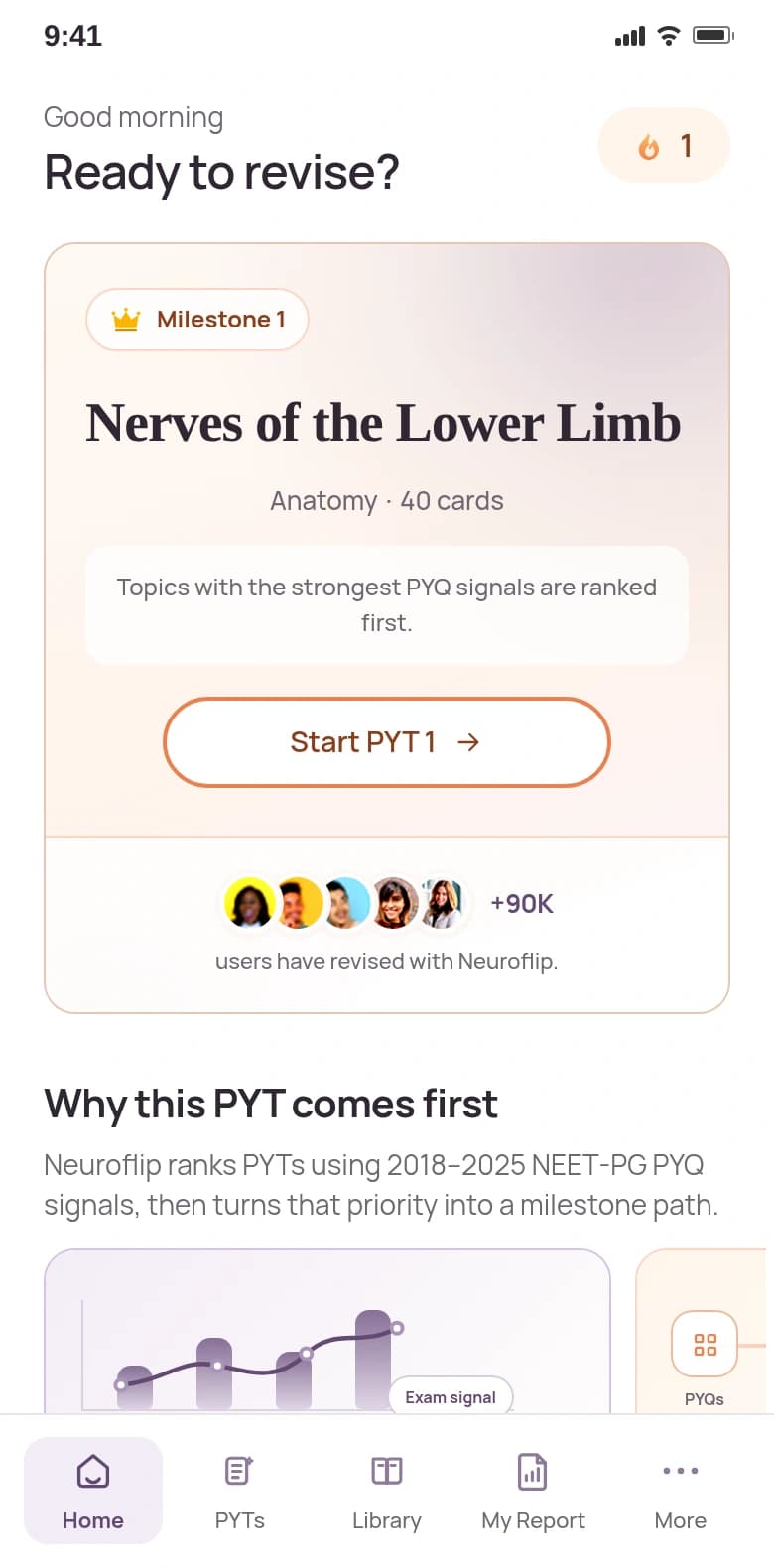
Choose your exam, explore each milestone and see real examples of where to start.
Historical PYQ evidence · approved V3.1.1
A manageable starting set prioritised from historical past-paper evidence.
Approximately 10% of mapped historical PYQ evidence—not predicted questions or full-syllabus coverage.
View download options →Three examples from the approved 33-topic NEET-PG starting set.
Historical evidence helps order revision; it does not predict future exam questions.
NEUROFLIP · REVISION GUIDES
Start with the questions that matter: which topics to prioritise, how milestones work, and how to plan FMGE revision.
Explore all articlesSee what historical NEET-PG questions can tell you about revision priorities.
Explore NEET-PG topicsUnderstand how the topic list grows—and what PYQ coverage really means.
Understand milestonesPrioritise historically tested topics while keeping your full preparation on track.
Plan FMGE revisionTopic priorities reflect mapped historical questions—not predictions about future exam papers.
Feedback from NeuroFlip users preparing for NEET-PG and FMGE.

“NeuroFlip transformed my study approach. Active recall and spaced repetition helped me master key topics. The flashcards were precise, covering everything essential for NEET PG success.”

“Managing multiple resources was tough until I found NeuroFlip. It simplified revision, keeping everything structured. The interactive format kept me engaged and improved my retention.”

“Cramming was stressful, but NeuroFlip changed that. The strategic approach strengthened weak areas, boosting my confidence before the fmge exam. It is must for every FMGE aspirants.”
Start with one clear target, not the whole syllabus. NeuroFlip uses past questions to build 10 milestones, so you know what to revise next.
Clear answers about NEET-PG and FMGE PYQs, INI-CET revision, flashcards and NeuroFlip milestones.
Read more: NEET-PG priority topics and how milestones work, and what is included in the flashcard app.
PYQs are previous-year questions; PYTs are the topics those questions test. Reviewing them can reveal recurring concepts and help you decide what to revise first. Past patterns do not predict the next paper.
Begin with previously tested topics you find difficult, then expand your coverage. NeuroFlip's exam-specific Milestone 1 contains 33 topics in the approved historical NEET-PG mapping. Use the topic list as a revision priority, not a substitute for the wider syllabus.
No. PYQs help you recognise tested concepts and practise exam-style questions, but they do not cover everything that could appear. Combine PYQs with your notes, clinical reasoning, new MCQs and full-length mock tests.
Yes. NeuroFlip provides prepared, subject-wise medical flashcards you can study without creating or importing decks. Try to recall each answer before revealing it, revisit uncertain cards with spaced repetition and practise related MCQs. Flashcards support revision but do not replace notes or mock tests.
The exams share much of the MBBS curriculum, but they test concepts in different ways. Keep a common foundation, add INI-CET-specific clinical and image-based question practice, and follow separate exam-specific PYQ priorities.
Use FMGE previous-year questions to spot topics worth revisiting, check why you missed MCQs and revisit weak concepts with flashcards. Maintain broad subject coverage and follow the latest NBEMS exam instructions.
The approved FMGE mapping includes 2,965 historical question occurrences across 1,042 topics with observed FMGE evidence. Milestone 1 includes 34 topics accounting for 305 occurrences (about 10.3%). The 10 cumulative milestones cover mapped historical evidence, not predicted future questions.
Milestone 1 is the first exam-specific revision set, representing approximately 10% of mapped historical PYQ evidence. Milestone 10 reaches 100% of that observed evidence, not 100% of the MBBS syllabus. NeuroFlip's full topic taxonomy contains 1,619 topics.
No. Use NeuroFlip to prioritise topics and practise recall with flashcards. Keep your primary notes for understanding, question banks for application and mock tests for exam-style practice and identifying weaknesses.